
'Openness is a great weapon in the armoury of more open societies. That's why the fight with Pakistan isn't just about India be six times bigger, but equally bitter and insecure Pakistan,' argues Shekhar Gupta.
.jpg)
Privatising public sector companies would have encountered significant opposition from their managers as well as from strong unions.
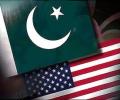
US Assistant Secretary of State for South and Central Asia Nisha Desai Biswal believes the India-US nuclear deal is not in limbo and it is for India and Pakistan to set the pace for conversations to resolve their issues. Rediff.com's Aziz Haniffa reports from Washington, DC.

'China's excessive military aid to Pakistan is the real elephant in the room as far as Sino-Indian relations are concerned. India should be confident enough to accept a degree of closeness between China and Pakistan, since China may wish to use this link for its foray into the Muslim world.' 'But the Chinese must be realistic enough to know that as time passes, the tactic of using Pakistan as a proxy to check India will yield diminishing returns. The US tried it for 60 years but failed, so will China,' says Colonel Anil A Athale (retd).

With projects worth Rs 1,28,000-cr, the group hopes to become one of the country's biggest industrial houses.

More than 10% (40 of 498 companies) have lost at least half their market value.
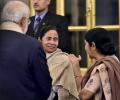
Prime Minister Narendra Modi has positioned himself as a credible partner for Bangladesh. He has scored by getting West Bengal Chief Minister Mamata Banerjee to travel with him to Dhaka, says Srinath Raghavan

'The irresistible Cuban cigars, which acquire their unique flavour as they are rolled on the thighs of Cuban women, have always been the ultimate temptation for cigar connoisseurs in the US.'

Narendra Modi's diplomacy and persuasive prowess has ensured long-term investments from China and Japan.

AAP candidates from Mumbai, Medha Patkar and Meera Sanyal, are poised to play a crucial and complementary role. While Patkar gives voice to the suffering of people at the grassroots, Sanyal is articulating the key principles that could build a more just and equitable society or economy, says Rajni Bakshi.

Indian economy about to take-off

Terrorism and Afghanistan were the focus points of Prime Minister Narendra Modi's talks with Uzbek President Islam Karimov on his first visit to Central Asia.

'India-US defence pacts are seen by many analysts as a subtle move to jointly contain China's growing militarism, especially in the strategic Indian Ocean Region.'

India has 20,000 tonnes of idle gold; gold is an important aspect of women empowerment: PM.

Prime Minister Manmohan Singh on Friday disagreed with those in the Congress who were dismissive of the challenge posed by Narendra Modi but asserted that the party would approach the 2014 Lok Sabha polls with self-confidence, irrespective of the results of the just concluded elections in five states.
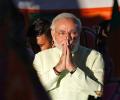
As Modi completes a year in office, his cuts in federal welfare spending on the poorest of India's 1.25 bn people are coming in for sharp criticism.
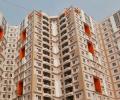
An analysis of the National Housing Bank's Residex shows from 2007 to now, almost all tier-II cities have seen their residential property prices appreciate by 45-120 per cent.

Incoming US President Donald Trump has assembled a core team that is -- not surprisingly -- overwhelmingly white and male.

Tarun Vijay on why the victory in Uttar Pradesh belongs to Narendra Modi and the road ahead.

The Forbes 30 Under 30 list is harder to get into than Stanford or Harvard University. Meet the desis who made the cut this year.

There's still little indication of forward movement in Indo-US defence relations.

ITC is one of those few enterprises in the world that has traversed a 100 year journey and has yet managed to remain contemporary, relevant and competitive.

As India gears up to honour its pravasis on January 9 to mark their contribution in the nation's development, rediff.com presents perspectives from eminent writers on the Diaspora. Kicking off the series is Ambassador T P Sreenivasan, who points out that the change of the Diaspora policy put in place by Rajiv Gandhi following the military coup in Fiji and his decision to stand by them, was the one defining moment in India's dealings with its overseas family.

As of now, in the case of China's border dispute with India, China is not likely to lose much if it does not resolve the dispute. In fact, the unresolved border dispute has much to offer to China, says Sana Hashmi.

Why is Xi Jinping visiting Saudi Arabia, Egypt and China this week? Former RA&W officer Jayadeva Ranade explains the significance of China's outreach to the Middle East.

In the first part of an exclusive interview with Sheela Bhatt/Rediff.com on the eve of the first year of the Narendra Modi-led NDA government, BJP President Amit Shah talks about the government's achievements and the controversy over the land ordinance.

'It has a natural inclination to foster as much competition among civilian politicians as possible.'

Think organic food, affordable homes, artificial intelligence, suggests Prof Manmeet Barve.

The challenges authorities face in cleaning Ganga and other holy rivers in Varanasi.

'The darkest days of Indian democracy were (during) the Emergency when basic democratic rights were suspended. For a time it seemed as though India would move along the East Asian model -- everybody works hard, nobody asks questions, certainly not of the government.' 'There are people who say we are headed that way, but I am not persuaded by the evidence,' says Mahesh Rangarajan who recently resigned as director of the Nehru Memorial Museum and Library in New Delhi.
Congress leader Jairam Ramesh interacts with readers on Rediff Chat as he discusses the period that changed India's history, forever.

20 Indian CEOs and 350 companies are participating in the Hannover Fair.
.jpg)
Can the leaky public distribution system, or PDS, deliver the subsidised grain to two-thirds of the population?

Claude Arpi gives a fascinating firsthand account of the Dalai Lama's arrival in Tawang in March 1959 and explains why he will once again receive a grand welcome, whether Beijing likes it or not.
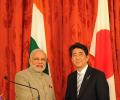
'Secretiveness and the element of surprise in announcing decisions marks the Modi style of diplomacy. From being a voluble politician, he became a reticent statesman... But the diplomatic dance is performed on thin ice and his adroitness is still to be proved,' says Ambassador T P Sreenivasan.

President Xi Jinping's visit may put relations between India and China on a new trajectory
India Inc is encouraged by a determined Budget.
The most immediate cause of worry is the recent volatility in foreign exchange markets, Prime Minister Manmohan Singh tells the Assocham annual general meeting.

India and China on Wednesday signed in all nine agreements, including the Border Defence Cooperation Agreement and one on strengthening cooperation on trans-border rivers, after restricted and delegation-level talks that lasted over two hours as Prime Minister Manmohan Singh and Premier Li Keqiang met for the second time this year for talks which the Indian leader described as "fruitful and productive".

'We are two countries that, as Swami Vivekananda said in Chicago more than a century ago, have sheltered the persecuted and the refugees of all religions and all nations on Earth.' 'People are watching to wait and see if this Modi moment is going to be the moment when the world's oldest democracy and the world's largest democracy finally capitalise on the full, inherent potential of this relationship.' Aziz Haniffa/Rediff.com reports from the State Department's lunch for Prime Minister Modi.
